
Ask any nurse leader what keeps them up the night before an audit, and it’s rarely a lack of clinical skills. It’s the anxiety of what’s lacking in their facility’s storage spaces and compliance processes.
When survey season hits, the collective stress on a unit skyrockets. There’s a heavy mental load: worrying if paper logs were signed, keys are missing, or expired supplies are lurking among the usable inventory. To cope, the short-term solution is a frantic 48-hour sweep to resolve potential issues to meet acceptable standards for hospital supply storage compliance.
The uncomfortable truth? Band-aid fixes create a perpetual cycle of stress and risk.
Hospital Supply Storage Compliance: Dangers Lurking in Short-Term Fixes
Relying on manual workarounds to achieve hospital supply storage compliance leads directly to staff burnout. Worse, operating in a state of constant storage triage puts patient health at risk long after auditors leavewasting precious bedside time searching for misplaced gear or risking contaminated supplies. Finally, the same issues will still be there and causing stress when it’s time for your next audit.
Achieving lasting clinical safety means moving beyond pre-audit panic and embedding permanent storage solutions into daily operations.
1. Physical Security: Access Control Storage Spaces
When evaluating storage spaces, standard locks often fail. Establishing role-based access controls ensures only authorized personnel enter supply areas while maintaining a clear audit trail.
What does “secure storage” really mean on the floor?
In a clinical setting, secure storage means controlled, trackable physical protection for medical supplies and high-value inventory. It prevents unauthorized entry without slowing down staff during a crisis. The Joint Commission’s Environment of Care standards require organizations to risk-assess and secure supply areas — which is pushing facilities beyond shared brass keys toward role-based access control.
The Red Flag
Unlocked supply spaces, brass keys left in cabinet doors, or basic latches that fail security expectations and offer zero access visibility.
Immediate Short-Term Fix (0–48 Hours)
Perform a physical lock audit across unit carts and rooms. Ensure latches catch, account for physical keys, and strictly enforce key-custody sign-out protocols.
- The Catch: Physical keys get lost, copied, or left in doors during busy shifts. It’s a high-stress band-aid that requires constant babysitting.
The Long-Term Functional Standard: Keyless Access & Cloud Management
Keyless proximity access paired with centralized cloud management eliminates key-tracking anxiety entirely while automatically capturing exact access timestamps for compliance and diversion prevention.
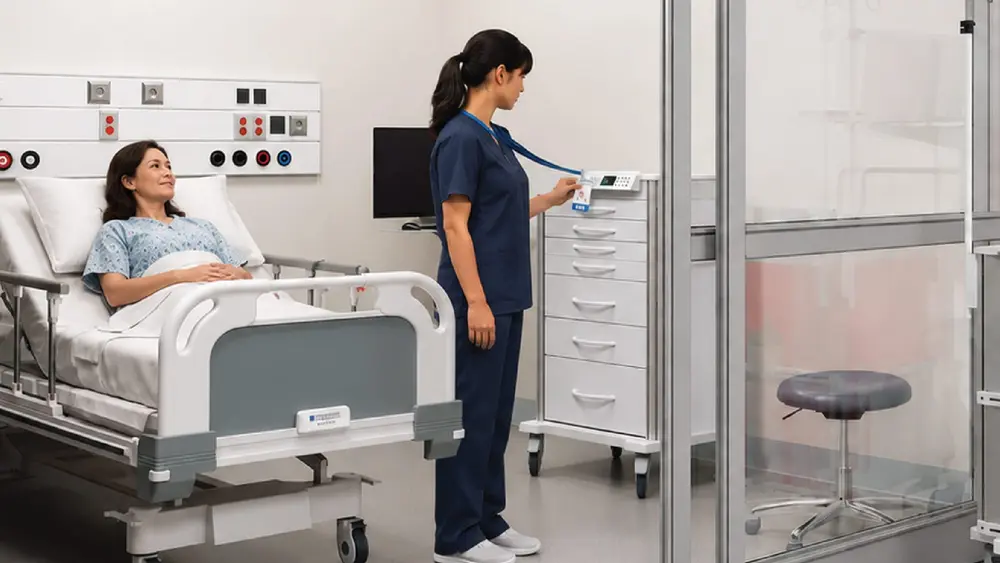
Innerspace Alignment: Upgrading to InterConnect Plus Locks with our cloud platform (available across Pace, Roam, and Evolve carts and cabinets) allows staff to tap in with their standard badge. Authorized personnel get instant access, while the system logs a digital audit trail in the cloud. No paper tracking required.
2. Scope Reprocessing & Endoscope Tracking Compliance
Scope cabinets represent one of the most critical specialty storage spaces in a facility, where illegible or improperly completed manual paper logs can lead to broken compliance processes and infection hazards.
How do surveyors evaluate scope cabinets and tracking processes?
Surveyors inspect scope storage cabinets according to AAMI ST91 standards for barrier integrity, proper drying ventilation, and non-porous surfaces, while auditing tracking compliance and logbooks for proper hang-times and reprocessing records. Because access control is a key component of endoscope tracking, auditors may look for defined user roles, clear key accountability, or electronic access logs.
The Red Flag
Red flags that auditors find include unsecured scope cabinets, unmonitored drying ventilation/surface integrity, missing or illegible paper logbooks, or chaotic check-in/check-out workflows. Missing a hang-time calculation or failing to log who accessed a scope isn’t just an audit finding. It’s a direct patient infection hazard. Failing to track hang-times per AAMI ST91 storage guidelines, or to accurately log scope serial numbers, undermines the drying and traceability practices noted in CDC guidelines for disinfection and sterilization, critical to preventing cross-contamination.
Immediate Short-Term Fix (0–48 Hours)
Conduct a three-point sweep: 1) Audit paper logbooks for complete serial numbers, patient IDs, and hang-time calculations; 2) Inspect physical cabinets to verify doors seal completely, ventilation is unobstructed, and internal surfaces are clean/non-porous; and 3) Re-establish strict physical key sign-out protocols for cabinet access control.
- The Catch: Manual paper logs get skipped during high-volume shifts, keys are easily left in locks or lost, and physical inspections only provide a single point-in-time check rather than continuous compliance.
The Long-Term Functional Standard: Digital Management
Fully integrated scope management automates physical drying, keyless access control, and digital chain-of-custody tracking in one workflow. Cabinets remain securely locked until an authorized ID badge is scanned, which automatically pairs scope serial numbers to user roles and logs precise hang-times, drying cycles, and check-in/check-out timestamps digitally.
Innerspace Alignment: The Ventaire Endoscopy System of products includes scope drying and tracking cabinets that feature automatic locking upon door closure, HEPA-filtered drying ventilation, integrated barcode scanners, and full Innerspace Cloud connectivity. They eliminate manual paper logbooks entirely while capturing an airtight, cloud-based audit trail for access control, drying status, and hang-time compliance.
3. Compliance Processes & Inventory Visibility: Adequate Stock or Expired Supplies
Preventing stockouts and expired supplies
Expired items on front-line shelves are a major red flag for surveyors. For care teams, however, the greater risk is discovering that critical supplies are missing right when a procedure begins.
The Red Flag
Deep, dark, or overcrowded drawers where supplies hide until long past their expiration date, or unmonitored depletion that leaves the unit short when supplies are needed.
Immediate Short-Term Fix (0–48 Hours)
Run a manual stock sweep. Pull expired or near-expiration items from front-line bins, check PAR (periodic automatic replenishment) levels, and place emergency re-orders.
- The Catch: Manual stock sweeps burn hours of nursing time and only provide a single point-in-time snapshot.
The Long-Term Functional Standard: Supply Chain Automation
Preventing stockouts and expired items requires moving away from periodic manual checks toward continuous compliance processes and supply chain automation solutions that give leadership real-time inventory visibility. Digital inventory intelligence that tracks usage timelines, monitors stock depletion, and sends proactive low-stock alerts to supply chain managers before you run out.
Innerspace Alignment: The Innerspace cloud delivers real-time visibility across connected carts and cabinets. It sends pro-active alerts when supplies run low to help ensure stock adequacy and curb waste without requiring manual sweeps.
4. Storage Culture Revelations
What unit storage reveals about your team’s culture
When surveyors see overcrowded shelves or boxes spilling onto floors, they aren’t just noting physical dust. They see two possible issues: a team stretched too thin to keep up, and an environment that lacks the right storage setup to support them. Organized storage is a direct mirror of operational discipline.
The Red Flag
Overcrowded open shelves, items blocking sprinkler heads (less than 18″ clearance), and dust collecting on open wire racks.
Immediate Short-Term Fix (0–48 Hours)
Clear top shelves to restore sprinkler clearance, wipe down wire racks, strip brown shipping cardboard from clean utility areas, and set basic visual reset expectations across shifts.
- The Catch: Open wire shelving constantly re-accumulates dust between routine cleanings, and manual sweeps don’t solve tight footprints or systemic chaos.
The Long-Term Functional Standard: High-Density Modular Storage
By standardizing how your team manages both physical storage spaces and daily compliance processes, audit preparation turns into a maintainable, effortless routine. Enclosed, high-density modular storage protects sterile supplies from airborne dust, maximizes vertical space, and builds an intuitive “culture of care” where organization is effortless.
Innerspace Alignment: Innerspace enclosed Evolve cabinets replace dusty wire racks with cleanable, protective enclosures. When equipped with FlexCell high-density interior components—such as trays, baskets, and dividers—they keep inventory organized and accessible. What’s more, as unit clinical needs evolve, their modular components can be easily swapped out or reconfigured at a fraction of the cost of new equipment, fostering long-term order and reducing daily staff frustration.
Moving From Survey Stress to Set-and-Forget Compliance
At the end of the day, pre-survey panic happens when compliance relies entirely on constant manual fixes. Short-term band-aids might get us through a walk-through, but long-term patient safety and staff retention thrive on intuitive physical systems and smart digital tools.
When you replace manual audit stress and stockouts with cloud-connected, automated storage solutions, compliance becomes automatic, leaving nurses with less anxiety and more time to focus on what actually matters: taking care of our patients.
Ready to Turn Audit Stress into Automated Compliance?
Don’t wait for a survey to expose hidden storage red flags. From keyless proximity locks to cloud-connected carts and cabinets, Innerspace provides purpose-built storage solutions designed to protect your supplies, save nursing time, and keep your department audit-ready 365 days a year. Explore Innerspace cloud, digital locking options, & smart storage solutions today.
Frequently Asked Questions

Denise Porter
RN, Nursing ManagerDenise Porter is a licensed registered nurse with over 20 years of experience. Having started her nursing career in high school as a nursing assistant, she worked her way up from CNA, to LPN, and ultimately earned her RN license. She’s spent her career following her passion for patient care, while gaining valuable experience in a variety of specialized healthcare settings.