
From the moment surgical instruments leave the operating room until they are opened for the next case, they move through a series of connected processes designed to protect patient safety and support efficient care delivery. This journey—from decontamination through assembly, sterilization, storage, and transport back to the operating room (OR)—relies on clearly defined control points where staff actions, equipment design, and environmental conditions influence outcomes.
“Most failures in the instrument journey occur at predictable control points—inspection, handling, storage, and transport”.
When those control points break down, the consequences are significant. Workflow gaps increase the risk of noncompliance, disrupt surgical instrument turnaround time, and strain sterile processing and perioperative teams. Identifying common risk areas along the instrument journey helps facilities prioritize standards adherence and apply controls that reduce variability and risk.
Step 1: Point of Use to Decontamination–Reducing the Initial Bioburden
Best practice: Instruments are pre-cleaned immediately after use to remove visible soil, often supported by enzymatic gels or foams that maintain a neutral pH and prevent drying. Soiled instruments are transported in covered, leak-proof containers along a defined route to decontamination.
Where risk is introduced:
- Inconsistent or skipped pre-cleaning
- Delayed transport allowing bioburden to dry
- Use of open or unlabeled containers
Standards takeaway: AAMI ST79:2017 emphasizes prompt pre-cleaning and controlled transport to reduce bioburden before mechanical cleaning begins.
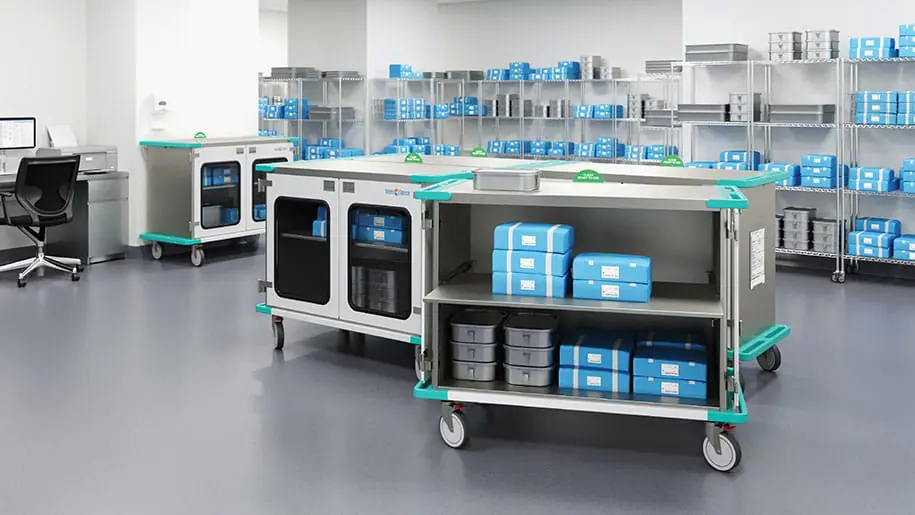
Closed case carts equipped with clear clean/dirty indicators—such as the Innerspace Integro Closed Case Carts—align with AAMI ST79 guidance for the containment and biohazard identification during transport, helping protect staff, patients, and the care environment.
Step 2: Cleaning and Decontamination–Ensuring a Repeatable Baseline
Best practice: Manual cleaning is followed by mechanical cleaning using ultrasonic cleaners and washers. Proper personal protective equipment, ergonomic layouts, and temperature control support consistent performance and staff safety—key components of sterile processing department (SPD) workflow optimization.
Where risk is introduced:
- Overloaded or improperly loaded washers
- Skipped steps under time pressure
- Manufacturer instructions for use (IFUs) not consistently followed
Standards takeaway: AAMI ST79 stresses adherence to IFUs and proper workflow design to ensure cleaning effectiveness and reduce variability.
Step 3: Assembly and Packaging–A Critical Safeguard
Best practice: Each instrument is inspected for cleanliness, damage, and function before assembly and packaging. This step is the most critical safeguard before sterilization.
Where risk is introduced:
- Missed debris or moisture
- Damaged or missing instruments
- Rushed assembly to meet case demand
Decision takeaway: Engineering controls—such as clean-side case carts staged for loading and roll-out shelving for heavy trays—help reduce handling errors and staff strain.
Step 4: Sterilization–Ensuring Proper Cycles
Best practice: Sterilization cycles are selected based on IFUs, with physical, chemical, and biological monitoring confirming performance. Loads are allowed to cool and dry completely to support event-related sterility maintenance.
Where risk is introduced:
- Incorrect cycle selection
- Incomplete review of monitoring results
- Wet packs caused by inadequate cooling
Standards takeaway: AAMI ST79 storage standards provide the framework for cycle selection, monitoring, and post-sterilization handling to maintain sterility assurance.
Sterile Processing Checklist for the Instrument Journey
[ ] Pre-cleaning at point of use: Remove visible soil and apply enzymatic gels/foams.
[ ] Cleaning and Decontamination: Use proper baseline cleaning in a neutral pH environment.
[ ] Inspection and Handling: Check for signs of wear, tears, holes, or moisture before loading.
[ ] Sterilization and Cooling: Ensure complete drying to prevent ‘wet packs’ and non-sterile items.
[ ] Sterile Storage: Use solid bottom shelves and maintain proper airflow and clearance.
[ ] Intra-Facility Transport: Use clean, dry, covered carts with rounded edges to prevent damage.
[ ] Maintain Separation: Never move clean supplies through dirty areas or mix items on the same cart.
Step 5: Sterile Storage Environmental Controls
Best practice: Sterile items are stored in a controlled environment with appropriate temperature and humidity, protected from dust, moisture, and traffic. Shelving supports airflow while preventing package damage—an essential component of sterile storage environmental controls.
Where risk is introduced:
- Wrap compression from stacked trays
- Mixed storage of clean and dirty items
- Shelving that damages packaging
Decision takeaway: AAMI recommends solid bottom shelves to prevent splash contamination and wire upper shelves for airflow. High density mobile shelving can maximize space while maintaining compliance, provided shelving meets AAMI requirements for clearance and cleanability.
Step 6: Transport to the OR–Applying Engineering Control
Best practice: Sterile instruments move along designated clean routes using closed case carts that protect packaging integrity. Clear clean/dirty indicators provide visual control and support readiness.
Where risk is introduced:
- Clean and dirty routes crossing
- Overloaded carts damaging packs
- Inadequate cart cleaning
Decision takeaway: Closed case carts act as a critical engineering control, with shelf configuration options, easily cleaned surfaces, and secure doors helping protect sterile contents during transport.
Step 7: Handoff in the OR–Last Inspection Before Use
Best practice: Case carts are staged in designated clean areas, and packaging is inspected before opening.
Where risk is introduced:
- Packaging damage discovered too late
- Unclear cart labeling
- Delayed delivery impacting case flow
Standards takeaway: Association of periOperative Registered Nurses (AORN) guidance supports inspection at point of use and reinforces the importance of maintaining package integrity through final handoff.
Final Perspective
Most failures in the instrument journey occur at predictable control points—inspection, handling, storage, and transport. While redundancy within SPD processes reduces risk, transport after sterilization remains a vulnerable phase. Closed case carts, when selected and used in alignment with AAMI standards, help preserve the integrity of upstream work. Ongoing evaluation of workflows, equipment, and environmental controls supports a safer, more reliable journey from decontam to OR.
FAQs
Additional Sources

Cindy Blye
Content WriterCindy Blye, BSN, RN, CCM is a Registered Nurse and Certified Case Manager. She is an Alumni of West Virginia University School of Nursing (BSN), and a member of the Association of Health Care Journalists and The Authors Guild.