
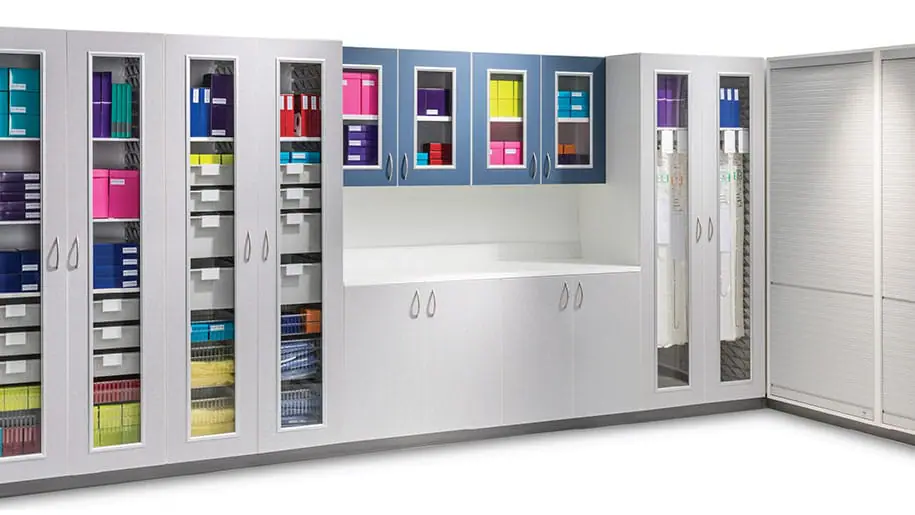
Healthcare storage rarely attracts attention—until it fails. Cabinet, cart, and hospital casework design are often taken for granted: always ready, always available, quietly supporting clinical services. As facilities evolve to keep pace with new medical technologies, “good enough” storage can feel like the most reasonable budget compromise.
Over time, storage compromises become costly. Inefficient layouts and makeshift storage slow workflows, increase contamination risks, frustrate staff, and can come under the scrutiny of surveyors.
For leaders responsible for purchasing and facility planning, storage is not cosmetic—it’s clinical and operational. The ROI of modular healthcare storage increases substantially across a variety of clinical and operational areas.
The Time Tax: How Inefficient Storage Steals Minutes From Care
Lost time spent searching for supplies stored in inconsistent or overcrowded spaces often leads staff to develop workarounds. Hoarding and hiding supplies become common when disorganization is routine.
Over time, these adaptations begin to feel normal. They are often invisible to leadership and eventually accepted as “the way we do things.”
But small delays add up to the cost of nursing workarounds in hospitals. Minutes spent hunting for items reduce efficiency and increase labor costs. More importantly, they interrupt the clinical standard of care—the benchmark defining what a reasonable provider would deliver under similar circumstances. When storage systems create friction, delays in care and near-misses become more likely.
Makeshift Healthcare Storage Solutions and Contamination Risks
Commercial storage is typically built for offices or retail environments. Healthcare-specific storage, by contrast, is designed for repeated disinfection, high supply turnover, and clear separation of clean and soiled zones. The difference between using durable hospital cabinets vs standard commercial grade products directly impacts infection prevention and survey readiness.
The U.S. Centers for Disease Control and Prevention emphasizes maintaining clean, dry, and protected storage environments and using surfaces that can withstand appropriate cleaning and disinfection protocols. When healthcare storage systems are not built for healthcare use, staff are left balancing workflow demands with environmental risk.
Open shelving not designed for clinical settings can be difficult to clean. Standard materials may degrade when exposed to hospital-grade disinfectants, leaving cracked or peeling surfaces where microbes can persist. Overflow items stored on counters or carts are exposed to dust and splashes, and clean and dirty storage zones may overlap.
During infection control surveys, these adaptations can quickly become compliance concerns—often reflecting environmental design limitations rather than individual staff behavior.
Staff usually know these fixes are not ideal. But in busy clinical settings, temporary solutions easily become habits.
Short-Term Savings, Long-Term Operational Costs
Upgrading storage can feel expensive upfront. Yet the long-term costs of generic solutions often outweigh the initial savings.
Common downstream expenses include:
- Retrofitting or replacing cabinets that can’t adapt
- Ongoing workflow inefficiencies
- Maintenance and repairs from material degradation
Commercial storage may appear cost-effective, but it is rarely built for the physical and chemical demands of 24 x 7 healthcare settings. Healthcare-specific storage systems, including modular cabinet systems and custom medical casework, are designed for durability, adaptability, and lifecycle performance.
When storage aligns with clinical realities from the start, standardization, scalability, and long-term cost control become achievable.
When Workarounds Become the System
Adaptations that keep workflows moving can hide deeper environmental problems. When questioned, staff often say, “This is the way we’ve always done it.”
Workarounds cost time with patients and increase cognitive and physical strain. Over time, environmental friction becomes normalized—even though it erodes staff satisfaction and contributes to burnout.
The Joint Commission defines the Environment of Care as the physical space, equipment, and systems that organizations manage to ensure patient and staff safety. When storage forces clinicians to compensate for design limitations, the environment is no longer supporting care—it’s depending on workarounds.
The physical environment should support safe, efficient care—not require heroics to make it function.
Why Healthcare-Specific Storage Changes the Equation
Storage designed specifically for clinical environments supports safe and efficient care. Custom healthcare casework aligns with staff workflows, while modular medical storage systems provide flexibility for evolving, high-volume patient areas.
Instead of forcing adaptation, healthcare-specific storage promotes consistency. Workarounds decrease, efficiency improves, and compliance becomes easier to maintain.
The difference is intentional design—anticipating disinfection protocols, patient flow, regulatory expectations, and long-term growth.
Is It Time to Reevaluate Your Storage?
Common warning signs include:
- Staff complaints about missing or hard-to-find supplies
- Overflow storage in hallways or patient care areas
- Survey findings linked to organization or infection prevention
- Frequent reconfiguration of carts and cabinets
When these patterns appear, it may be time to assess whether storage systems are supporting care or quietly undermining it.
Storage: A Strategic Asset
Healthcare storage influences nursing workflow, compliance, staff morale, and long-term costs. Short-term savings can create long-term consequences.
Strategic investment in healthcare-specific storage supports patients, protects staff, and strengthens regulatory readiness—without repeated retrofits or premature replacement.
When storage works, it fades into the background. But when it’s intentionally aligned with clinical care, it quietly empowers staff, protects patients, and strengthens the facility for years to come—making purposeful storage an essential component of lasting healthcare excellence.
Frequently Asked Questions

Cindy Blye
Content WriterCindy Blye, BSN, RN, CCM is a Registered Nurse and Certified Case Manager. She is an Alumni of West Virginia University School of Nursing (BSN), and a member of the Association of Health Care Journalists and The Authors Guild.